
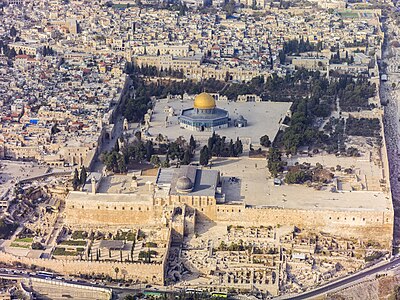
Jerusalem: Three Faiths, One City, Endless Devotion
No city on Earth is sacred to more people. How Jerusalem became the spiritual epicenter for Judaism, Christianity, and Islam.
The City of God
Jerusalem occupies barely 1 square kilometer of sacred ground — yet for over 3,000 years, it has been the spiritual epicenter for three of the world's great monotheistic religions. No other city on Earth carries such concentrated holiness.
Judaism: The First Temple
King Solomon built the First Temple here around 957 BCE, establishing Jerusalem as the dwelling place of God on Earth. When the Babylonians destroyed it in 586 BCE, the Jewish people's connection to the city only deepened. The Second Temple, built on the same site, stood until the Romans destroyed it in 70 CE. The Western Wall — the last remnant — remains the holiest accessible site in Judaism.
Christianity: Death and Resurrection
For Christians, Jerusalem is where Jesus taught, was tried, crucified, buried, and — they believe — rose from the dead. The Via Dolorosa traces his path to crucifixion. The Church of the Holy Sepulchre marks the sites of both crucifixion and resurrection. The Mount of Olives overlooks the city where he ascended to heaven.
Islam: The Night Journey
Muslims believe the Prophet Muhammad was miraculously transported from Mecca to Jerusalem in one night (the Isra), and from the rock on the Temple Mount ascended through the seven heavens (the Mi'raj). The Dome of the Rock and Al-Aqsa Mosque mark this spot, making it Islam's third holiest site.
Living Together
Today, an intricate web of agreements, traditions, and tensions governs access to Jerusalem's holy sites. A Muslim family has held the key to the Church of the Holy Sepulchre since the 12th century. The Status Quo, a set of rules from 1757, still governs who can worship where and when.
Jerusalem's holiness is both its glory and its burden. It is a city that inspires the highest human aspirations — and sometimes the lowest human conflicts.
The Most Contested Sacred City on Earth
Jerusalem is unique in human geography: a city of fewer than one million people that serves as a spiritual capital for roughly half the world's population. Jews, Christians, and Muslims all consider it among their holiest places, and the competing claims to the same physical space have produced some of history's most intense conflicts — but also some of its most remarkable examples of coexistence. Understanding how three faiths relate to this single city is essential for anyone planning to visit.
Jewish Jerusalem: 3,000 Years of Yearning
Jerusalem's sanctity in Judaism begins with the binding of Isaac on Mount Moriah, continues through King David's establishment of the city as his capital around 1000 BCE, and reaches its zenith with Solomon's construction of the First Temple. The Temple served as the singular dwelling place of God's presence (the Shekinah) on Earth, and its destruction — first by Babylon in 586 BCE and again by Rome in 70 CE — remains the central trauma of Jewish history. The Western Wall (Kotel), the last remaining retaining wall of the Temple Mount platform, is the holiest site where Jews can pray. For two thousand years of diaspora, Jews prayed facing Jerusalem and concluded the Passover seder with the words "Next year in Jerusalem." The city's capture by Israel in 1967 was experienced by many Jews as a messianic moment — the return to the heart of their spiritual homeland after two millennia.
Christian Jerusalem: The Geography of Salvation
For Christians, Jerusalem is holy primarily because of the events of Holy Week: Jesus's triumphal entry, the Last Supper, the agony in Gethsemane, the trial, crucifixion at Golgotha, burial, and resurrection. The Church of the Holy Sepulchre, built over the traditional sites of the crucifixion and empty tomb, is the holiest site in Christianity. The Via Dolorosa (Way of Suffering) retraces Jesus's path carrying the cross through the Old City. The Mount of Olives, where Jesus ascended to heaven according to the Gospels, and the room of the Last Supper on Mount Zion are also major pilgrimage sites. Six different Christian denominations share custody of the Holy Sepulchre under an arrangement dating to 1757, and the famous "immovable ladder" — a wooden ladder placed on a ledge above the entrance before 1757 that no denomination can move — symbolizes both the delicacy and the absurdity of this arrangement.
Islamic Jerusalem: The Night Journey
Jerusalem (Al-Quds, "The Holy") is Islam's third holiest city, after Mecca and Medina. Its sanctity derives primarily from the Isra and Mi'raj — the Prophet Muhammad's Night Journey from Mecca to Jerusalem and subsequent ascension through the seven heavens. The Dome of the Rock, completed in 691 CE, marks the spot on the Temple Mount (Haram al-Sharif, "Noble Sanctuary") from which Muhammad ascended. Al-Aqsa Mosque, at the southern end of the same platform, was the first qibla (direction of prayer) in Islam before it was changed to Mecca. The compound containing both structures is the third holiest site in Islam and can accommodate up to 400,000 worshippers during Ramadan.
Walking the Old City
Jerusalem's Old City, enclosed within Ottoman-era walls, covers just one square kilometer but contains an almost impossible density of sacred sites. The four traditional quarters — Jewish, Christian, Muslim, and Armenian — each have distinct characters, though the boundaries are not rigid. A walking tour beginning at the Jaffa Gate can cover the major sites in a single (exhausting) day, but serious exploration requires at least three to four days.
The Temple Mount/Haram al-Sharif is open to non-Muslim visitors during limited hours (typically Sunday through Thursday mornings), entering through a wooden ramp near the Western Wall. Modest dress is required and strictly enforced. The Western Wall is accessible 24 hours a day, seven days a week, though security screening can produce long lines on Friday evenings and holidays.
The Church of the Holy Sepulchre opens at 4 AM (5 AM in winter) and the early morning hours offer the best chance to experience the space without overwhelming crowds. The Via Dolorosa is best walked on Friday afternoons, when a Franciscan-led procession retraces the traditional 14 Stations of the Cross.
The Politics of Sacred Space
Any honest guide to Jerusalem must acknowledge the political dimension. The city's status is the most sensitive issue in the Israeli-Palestinian conflict, with both peoples claiming it as their capital. Visitors will encounter different narratives depending on whom they speak with and which quarter they are in. The name you use for the Temple Mount/Haram al-Sharif alone signals political sympathies. The most respectful approach is to listen to all perspectives, acknowledge the genuine pain and legitimate claims on all sides, and resist the temptation to reduce an impossibly complex situation to a simple narrative.
Practical Tips
Dress modestly everywhere in the Old City. Carry water — the stone streets amplify heat in summer. Friday is the Muslim holy day and many shops in the Muslim Quarter close; Saturday is the Jewish Sabbath and the Jewish Quarter largely shuts down; Sunday morning is the quietest time in the Christian Quarter. Allow extra time for security checkpoints. And be prepared to be moved — whatever your beliefs or lack thereof, the cumulative weight of three thousand years of devotion in such a small space is unlike anything else on Earth.

