
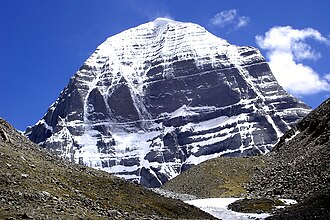
Five Religions, One Mountain: The Mystery of Mount Kailash
No one has ever climbed Mount Kailash. Sacred to Hindus, Buddhists, Jains, and Bön followers, this remote Tibetan peak guards its secrets.
The Unclimbed Mountain
At 6,638 meters, Mount Kailash in western Tibet is not the tallest peak in the Himalayas, nor the most technically challenging. Yet no human has ever stood on its summit — and likely none ever will. Out of respect for its spiritual significance to four religions, the Chinese government has banned all climbing attempts.
Sacred to Four Faiths
Hinduism: Mount Kailash is the abode of Lord Shiva, who sits atop the peak in eternal meditation with his consort Parvati. The mountain represents the cosmic axis (axis mundi) around which the universe revolves.
Buddhism: The mountain is associated with Buddha Demchok (Chakrasamvara), representing supreme bliss. The great Buddhist saint Milarepa is said to have defeated a Bön priest in a magical contest on its slopes.
Jainism: Kailash is Mount Ashtapada, where the first Jain Tirthankara, Rishabhadeva, attained spiritual liberation (moksha).
Bön: The pre-Buddhist Bön religion of Tibet considers Kailash the seat of all spiritual power, the place where their founder descended from heaven.
The Kora: A Sacred Circuit
Pilgrims from all four traditions circumambulate the mountain in a 52 km circuit called a kora. Hindus and Buddhists walk clockwise; Bön practitioners walk counterclockwise. Completing one kora is said to erase the sins of a lifetime. Completing 108 guarantees enlightenment.
The full circuit takes 1-3 days at altitudes exceeding 5,000 meters. The highest point, Dolma La pass at 5,636 meters, is both physically and symbolically the point of death and rebirth.
The Phenomenon of Multi-Faith Sacred Mountains
Mountains have been considered sacred across virtually every human culture. Their physical characteristics — height, inaccessibility, dramatic weather, proximity to the sky — naturally lend themselves to spiritual interpretation. But certain mountains have achieved the remarkable status of being sacred to multiple religious traditions simultaneously. This multi-faith reverence suggests something universal about these particular peaks, something that transcends doctrinal boundaries and speaks to a shared human capacity for awe.
Mount Kailash: Unclimbed, Unclaimed, Universal
Mount Kailash in western Tibet is perhaps the most remarkable multi-faith sacred mountain on Earth. Standing at 6,638 meters, it is sacred to four religions — Hinduism, Buddhism, Jainism, and Bon — representing well over two billion people. Hindus consider it the abode of Lord Shiva and the center of the universe. Buddhists associate it with the Buddha Demchok, representing supreme bliss. Jains revere it as the site where their first Tirthankara, Rishabhadeva, attained spiritual liberation. And followers of the indigenous Tibetan Bon tradition consider it the seat of all spiritual power.
Despite its relatively modest height by Himalayan standards, Mount Kailash has never been climbed. This is not because it is technically impossible — it would likely be a manageable ascent for experienced mountaineers — but because all four religious traditions consider it sacrilege to set foot on the summit. The Chinese government has respected this prohibition, refusing climbing permits since the 1980s. In a world where every mountain seems destined for conquest, Kailash remains inviolate by universal consent.
The Kora: Circumambulation as Worship
The primary form of worship at Mount Kailash is the kora — a circumambulation of the mountain's base covering approximately 52 kilometers. Hindus and Buddhists walk clockwise; Bon practitioners walk counterclockwise. The circuit typically takes three days, crossing the Drolma La pass at 5,636 meters. Some Tibetan Buddhist pilgrims complete the circuit by continuous prostration — lying flat on the ground, marking the spot with their fingers, standing, walking to the mark, and prostrating again — a process that takes two to three weeks of intense physical devotion.
Tradition holds that completing 108 koras guarantees enlightenment. Even a single circumambulation is believed to erase the sins of a lifetime. During the Saga Dawa festival (celebrating the Buddha's birth, enlightenment, and death), thousands of pilgrims converge on the mountain, creating a remarkable gathering of multiple faiths united in their reverence for a single peak.
Mount Sinai: Where Moses Met God
Mount Sinai in Egypt's Sinai Peninsula is sacred to Judaism, Christianity, and Islam as the place where God gave Moses the Ten Commandments. Jewish tradition places this event at the very foundation of the covenant between God and the people of Israel. Christians revere the site for the same reason and also associate it with the Monastery of Saint Catherine, one of the oldest continuously operating Christian monasteries in the world, founded in the 6th century CE. Islamic tradition calls the mountain Jabal Musa (Mountain of Moses) and includes the account of Moses receiving divine revelation in the Quran.
Today, pilgrims of all three Abrahamic faiths climb the 2,285-meter peak, typically beginning the ascent at 2 AM to reach the summit for sunrise. The experience of watching dawn break over the desert from the place where tradition says God spoke to Moses is one of the most powerful pilgrim experiences in the world.
Adam's Peak, Sri Lanka: Four Faiths, One Footprint
Sri Pada, or Adam's Peak, in the central highlands of Sri Lanka is sacred to Buddhists, Hindus, Muslims, and Christians. At the summit sits a rock formation bearing what appears to be a giant footprint. Buddhists believe it is the footprint of the Buddha. Hindus attribute it to Lord Shiva. Muslims and some Christians believe it marks where Adam first set foot on Earth after being cast out of Eden (hence the English name Adam's Peak). The annual pilgrimage season, from December to May, sees thousands of pilgrims climbing the 5,500 stone steps in darkness to arrive at the summit for dawn, where they witness the mountain's perfect triangular shadow stretching across the landscape below.
What Multi-Faith Mountains Teach Us
The existence of mountains sacred to multiple faiths suggests that certain landscapes possess qualities that humans across cultures interpret as sacred. Whether this is a function of geology, psychology, or genuine spiritual reality is a question each visitor must answer for themselves. What is undeniable is that these mountains have inspired some of humanity's deepest spiritual experiences across thousands of years and multiple traditions. They stand as powerful evidence that despite our religious differences, we share a common capacity for transcendence.

